Kathryn Kreckel
Emmy Noether Project
Resolving the Baryon Cycle within Nearby Galaxies
 Emmy Noether Research Project, funded by the DFG (2019-2026)
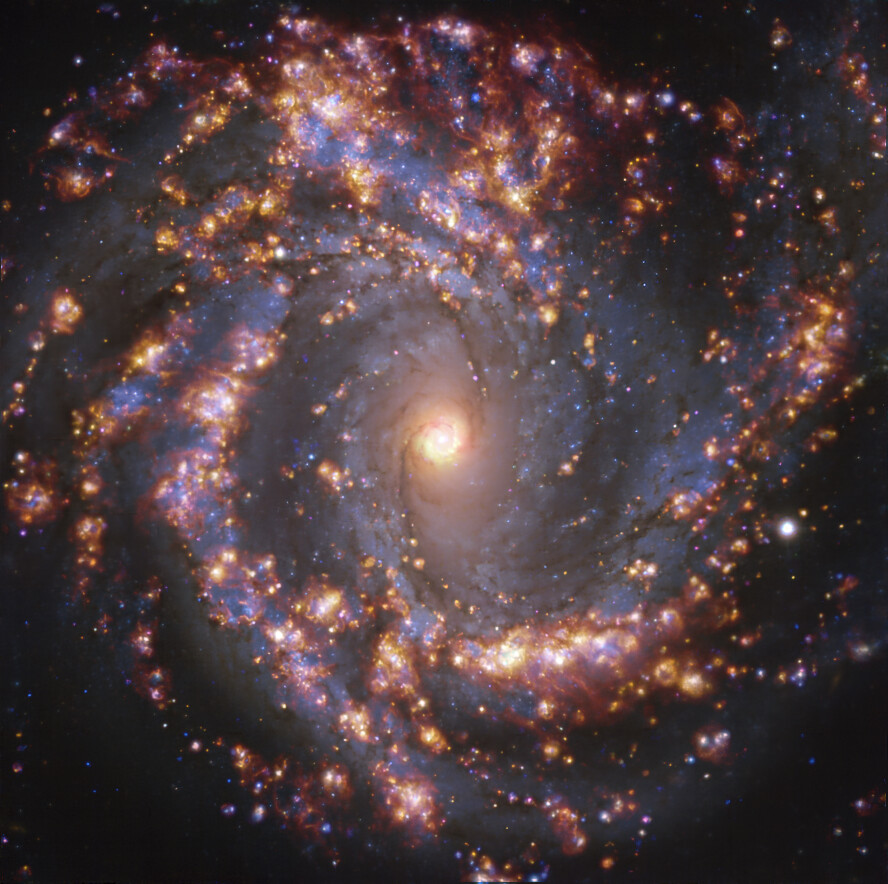
To understand galaxies, we must understand the physical processes and local conditions that drive their buildup of stellar mass through star formation. This evolution is regulated through the baryon cycle, the transformation of gas into stars and eventual ejection and recycling of that material to form the next generation of stars. The relevant physics occurs on the 50 pc scales of individual molecular clouds, star forming HII regions and supernova remnants, only now accessible in a diverse sample of external galaxies. My research group works within the PHANGS collaboration to use ALMA and VLT observations to identify and characterize the physical conditions in and around HII regions and ask: How does metal enrichment proceed within the disk? Does the injection of energy and momentum from stellar winds and supernovae trigger or suppress star formation? What is the source of ionization in the diffuse ionized gas? Addressing these topics ultimately requires us to map the internal ionization structure of star-forming regions, which will be undertaken in an ambitious new Local Volume Mapper (LVM/SDSS-V) spectroscopic survey of the Milky Way and Local Group galaxies.
Project Members
- Kathryn Kreckel (group leader)
- Jose Eduardo Mendez Delgado (postdoc, now faculty at UNAM)
- Oleg Egorov (postdoc, now research fellow at Heidelberg University)
- Elizabeth Watkins (postdoc, now postdoc at Manchester University)
- Fabian Scheuermann (PhD student)
- Jing Li (PhD student)
- Silvia Popa (Masters student, now PhD student at MPA)
- Mar Canal i Saguer (Masters student, now PhD student at FAU)
- Ema Zavodnik (Bachelors student)
Key published results
- Kreckel, Egorov, et al. 2026, SDSS-V LVM: Verifying what, and where, the 'Galactic Center' Lobe is [ADS]
- Barnes, Chandar, Kreckel, et al. 2026, The PHANGS-MUSE/HST-Hα nebulae catalogue: Parsec-scale resolved structure, physical conditions, and stellar associations across nearby galaxies [ADS]
- Scheuermann, Kreckel et al. 2026, Stellar associations powering H II regions: II. Escape fraction of ionising photons [ADS]
- Barnes, Chandar, Kreckel et al. 2025, The PHANGS-MUSE/HST-Halpha Nebulae Catalogue [ADS]
- Barrera-Ballesteros, Sánchez, Kreckel et al. 2025, Physical Properties of HII Regions at Sub-kpc Scales Using Integral Field Spectroscopy on IC 342 [ADS]
- Congiu, Scheuermann, Kreckel, et al. 2025, The MUSE view of the Sculptor galaxy: survey overview and the planetary nebulae luminosity function [ADS]
- Méndez-Delgado, et al. 2025, Generalized Te([O III])–Te(He I) Discrepancies in Ionized Nebulae: Possible Evidence of Case B Deviations and Temperature Inhomogeneities [ADS]
- Drory, Blanc, Kreckel, et al. 2024, The SDSS-V Local Volume Mapper (LVM): Scientific Motivation and Project Overview [ADS]
- Méndez-Delgado, Kreckel, et al. 2024, Gas-phase Fe/O and Fe/N abundances in Star-Forming Regions. Relations between nucleosynthesis, metallicity and dust [ADS]
- Li, Kreckel, et al. 2024, Discovery of ~2200 new supernova remnants in 19 nearby star-forming galaxies with MUSE spectroscopy [ADS]
- Kreckel, Egorov, Egorova, et al. 2024, SDSS-V Local Volume Mapper (LVM): A Glimpse into Orion [ADS]
- Méndez-Delgado, et al. 2024, Effects of density and temperature variations on the metallicity of Mrk 71 [ADS]
- Reyes-Rodriguez, Méndez-Delgado, et al. 2024, Excitation mechanisms of C II optical permitted lines in ionized nebulae [ADS]
- Egorov, Kreckel, et al. 2023, Quantifying the energy balance between the turbulent ionised gas and young stars [ADS]
- Méndez-Delgado, et al. 2023, Temperature inhomogeneities cause the abundance discrepancy in H II regions [ADS]
- Méndez-Delgado, et al. 2023, Density biases and temperature relations for DESIRED HII regions [ADS]
- Scheuermann, Kreckel, et al. 2023, Stellar associations powering H II regions - I. Defining an evolutionary sequence [ADS]
- Watkins, Kreckel, et al. 2023, Quantifying the energetics of molecular superbubbles in PHANGS galaxies [ADS]
- Groves, Kreckel, et al. 2023, The PHANGS-MUSE Nebular Catalogue [ADS]
- PHANGS-JWST First Results:
- Egorov, Kreckel, et al. 2023, PHANGS-JWST First Results: Destruction of the PAH molecules in HII regions probed by JWST and MUSE [ADS]
- Watkins, et al. 2023, PHANGS-JWST First Results: A statistical view on bubble evolution in NGC628 [ADS]
- Barnes, Watkins, et al. 2023, PHANGS-JWST First Results: Multi-wavelength view of feedback-driven bubbles (The Phantom Voids) across NGC 628 [ADS]
- Kreckel, Egorov, et al 2022, A physically motivated `charge-exchange method' for measuring electron temperatures within HII regions [ADS]
- Scheuermann, Kreckel et al. 2022, Planetary Nebula Luminosity Function distances for 19 galaxies observed by PHANGS-MUSE [ADS]
- Williams, Kreckel et al. 2022, The 2D metallicity distribution and mixing scales of nearby galaxies [ADS]
- Barnes, Chandar, Kreckel et al. 2022 Linking stellar populations to HII regions across nearby galaxies: I. Constraining pre-supernova feedback from young clusters in NGC1672 [ADS]
- Santoro, Kreckel, et al. 2022 PHANGS-MUSE: The H II region luminosity function of local star-forming galaxies [ADS]
- Lamarche, Smith, Kreckel et al. 2022 Direct Far-infrared Metal Abundances (FIRA). I. M101 [ADS]
- Egorov et al. 2021, Star formation in the nearby dwarf galaxy DDO 53: interplay between gas accretion and stellar feedback [ADS]
- Barnes, Glover, Kreckel et al. 2021 Comparing the pre-SNe feedback and environmental pressures for 6000 H II regions across 19 nearby spiral galaxies [ADS]
- Kreckel et al. 2020, Measuring the mixing scale of the ISM within nearby spiral galaxies [ADS]
- Kreckel et al. 2019, Mapping metallicity variations across nearby galaxy disks [ADS]