Kathryn Kreckel
ISM-METALS
Funded by the European Research Council (ERC) Starting Grant
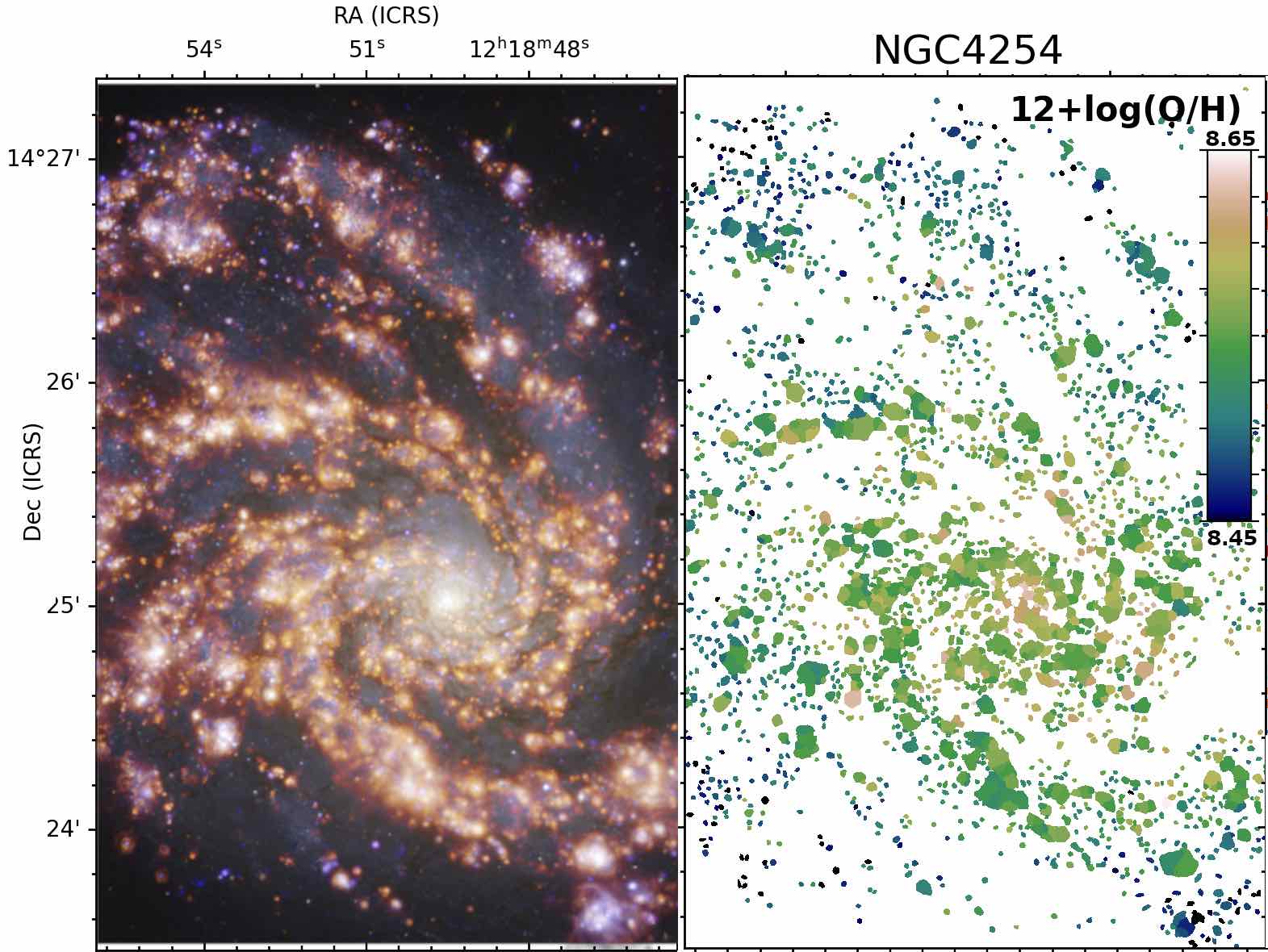
The introduction of heavy elements (metals) into the interstellar medium (ISM) via stellar feedback processes is crucial for the regulation of star formation and thus galaxy evolution. Metals set the heating and cooling balance in star-forming regions, and establish the carbon chemistry that is necessary for life on our planet. The gas-phase metal abundance (metallicity) is the most accessible measure of the build-up of chemical enrichment over cosmic time. However, there are large systematic uncertainties in our metallicity measurements, to the extent that we do not know if most galaxies are metal-rich or metal-poor compared to the Milky Way. These long-standing uncertainties plague our understanding of metal variations, but can now be addressed by vast new homogeneous data sets resolving tens of thousands of individual HII regions across nearby galaxies. This ambitious ERC starting grant tackles this problem by applying a data-driven approach to emission line measurements in our own Milky Way, Local Group galaxies (SDSS-V/LVM) and more distant Local Volume galaxies (PHANGS-MUSE). This project aims to resolve long-standing discrepancies in absolute metallicity calibrations and develop new and robust prescriptions that directly address electron temperature uncertainties. We will apply our methods to map out metallicity variations across more than 50 galaxies, providing quantitative constraints on the mixing scale and correlations with local physical conditions in the ISM. By establishing a new homogeneous local benchmark for absolute metallicity measurements, the ISM-METALS project will build a foundation for future studies of galaxy metallicities, enabling the robust interpretation of metallicity variations soon to be measured across cosmic time with upcoming new facilities (JWST, ELT).
Project Members
- Kathryn Kreckel (group leader)
- Evgeniia Egorova (postdoc)
- Fu-Heng "Eric" Liang (postdoc)
- Natascha Sattler (PhD student)
- Hannah Greve (Masters student)
- Michael Huber (Masters student)
Key publications
- Kreckel, Egorov, et al. 2026, SDSS-V LVM: Verifying what, and where, the 'Galactic Center' Lobe is [ADS]
- Sattler, Méndez-Delgado, Kreckel et al. 2026, SDSS-V LVM: Resolving physical conditions in the Trifid Nebula [ADS]
- Fu-Heng, et al. 2026, WISDOM Project ─ XXVII. Giant molecular clouds of the lenticular galaxy NGC 1387: similarities with spiral galaxy clouds [ADS]
- Kollmeier, et al. (incl. Kreckel, Egorova, Sattler), 2026, Sloan Digital Sky Survey. V. Pioneering Panoptic Spectroscopy[ADS]
- Hilder, Casey, Dalcanton, Kreckel, et al. 2026, Unified Spectrospatial Forward Models: Spatially Continuous Maps of Weak Emission Lines in the Rosette Nebula with SDSS-V LVM [ADS]
- Kreckel, et al (incl. Egorova, Liang), 2025, Temperature based radial metallicity gradients in nearby galaxies [ADS]
- Egorova, Kreckel et al, 2025, Chemodynamic evidence of pristine gas accretion in the void galaxy VGS 12 [ADS]
- González-Torà, Sander, Egorova, et al (incl. Kreckel, Liang), 2025, SDSS-V LVM: Detectability of Wolf-Rayet stars and their He II ionizing flux in low-metallicity environments I. The weak-lined, early-type WN3 stars in the SMC [ADS]
- SDSS collaboration (incl. Egorova, Greve, Kreckel, Liang, Sattler), 2025, The Nineteenth Data Release of the Sloan Digital Sky Survey [ADS]
- Kollmeier et al (incl. Egorova, Kreckel, Sattler), 2025, Sloan Digital Sky Survey-V: Pioneering Panoptic Spectroscopy [ADS]
- Barrera-Ballesteros, Sánchez, Kreckel et al. 2025, Physical Properties of HII Regions at Sub-kpc Scales Using Integral Field Spectroscopy on IC 342 [ADS]
- Congiu, Scheuermann, Kreckel, et al. 2025, The MUSE view of the Sculptor galaxy: survey overview and the planetary nebulae luminosity function [ADS]
- Méndez-Delgado, et al. (incl. Kreckel), 2025, Generalized Te([O III])–Te(He I) Discrepancies in Ionized Nebulae: Possible Evidence of Case B Deviations and Temperature Inhomogeneities [ADS]
- Nemer, Méndez-Delgado, Sattler, et al. Analyzing the Abundance Discrepancy Problem in HII Regions with Photoionization Modeling [ADS]
- Drory, Blanc, Kreckel, et al. 2024, The SDSS-V Local Volume Mapper (LVM): Scientific Motivation and Project Overview [ADS]
- Méndez-Delgado, Kreckel, et al. 2024, Gas-phase Fe/O and Fe/N abundances in Star-Forming Regions. Relations between nucleosynthesis, metallicity and dust [ADS]
- Kreckel, Egorov, Egorova, et al. (incl. Sattler) 2024, SDSS-V Local Volume Mapper (LVM): A Glimpse into Orion [ADS]
- Méndez-Delgado, et al. (incl. Kreckel), 2024, Effects of density and temperature variations on the metallicity of Mrk 71 [ADS]