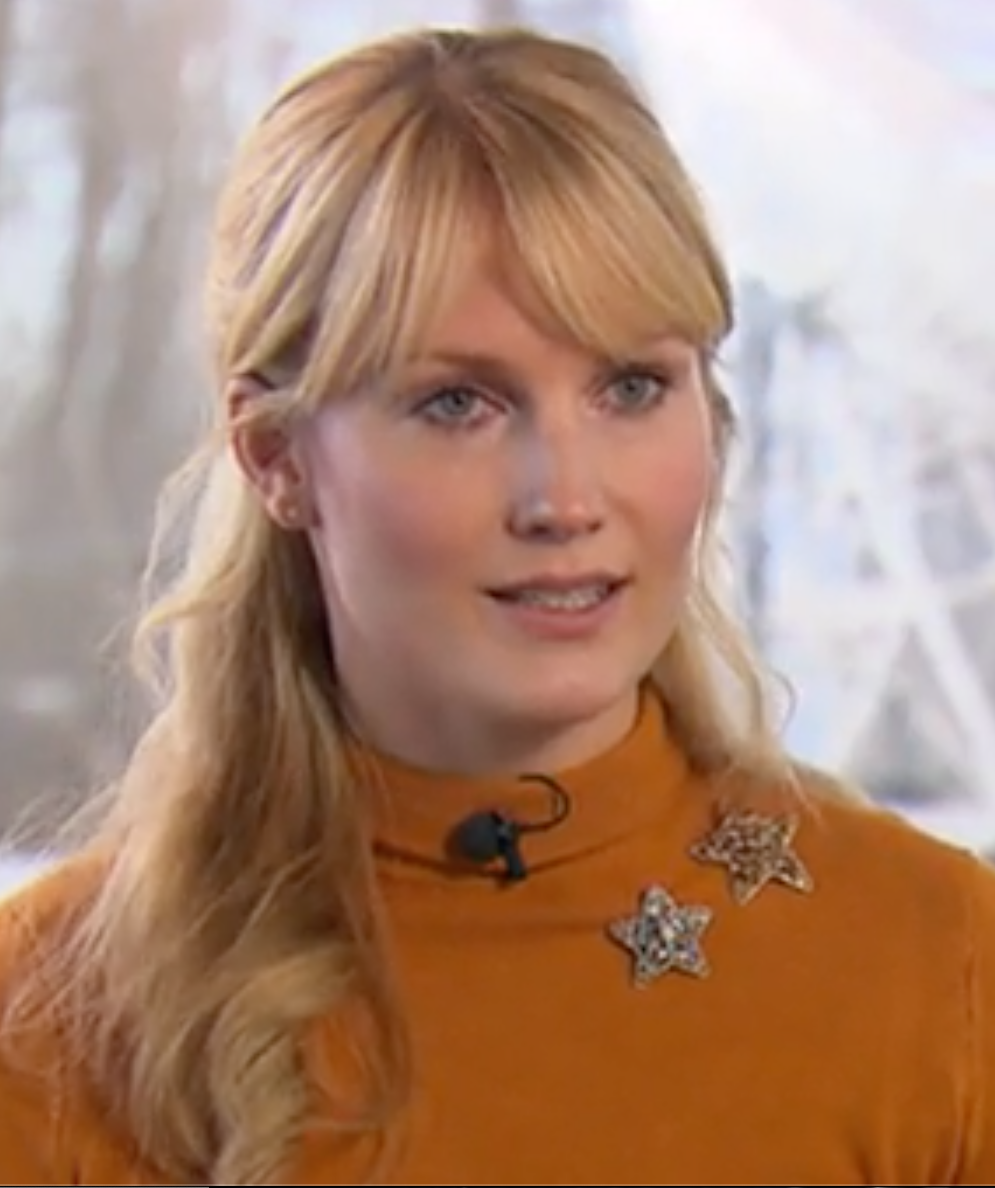
Professor for Extragalactic Astrophysics
Dominika Wylezalek
Astronomisches Rechen-Institut, Zentrum für Astronomie der Universität Heidelberg
“Selbst wenn wir tausendfach das ‘Nichts’ an die Außenwände des Universums geschrieben hätten, würden wir uns letztlich dennoch fragen, was hinter diesen Grenzen liegt.” — B. Schüll
About
Studying black holes and the galaxies that host them
I am a full professor for extragalactic astrophysics at the Astronomisches Rechen-Institut, Center for Astronomy at Heidelberg University, where I lead the research group GALENA. Feel free to contact me about potential PhD, Master, or Bachelor projects in our group.
Before starting this position in March 2025, I was an independent Emmy Noether Research Group Leader at Heidelberg University, an ESO Fellow at the European Southern Observatory in Garching bei München, and an Akbari-Mack and Provost Diversity Postdoctoral Research Fellow in the Department of Physics & Astronomy at Johns Hopkins University in Baltimore, USA. I completed my PhD at the Ludwig-Maximilians-Universität München and ESO as a fellow of the International Max Planck Research School on Astrophysics (IMPRS).
The goal of my research is to understand how galaxies form and evolve, and what physical processes matter most at different cosmic epochs and spatial scales. I am particularly fascinated by supermassive black holes which are some of the most mysterious objects astronomers have tried to understand for over a century, ever since Karl Schwarzschild presented his solutions to the Einstein field equations in 1916. Supermassive black holes are now thought to be hosted by every massive galaxy in the Universe, and the energy output of actively accreting black holes (active galactic nuclei, AGN) has become a critical ingredient in modern galaxy formation theories. I use multi-wavelength photometric and spectroscopic observations to address AGN physics, feedback signatures, and the role of AGN in galaxy evolution, and I am also very interested in the build-up of large-scale structure in the early Universe, actively working on high-redshift galaxy cluster studies.
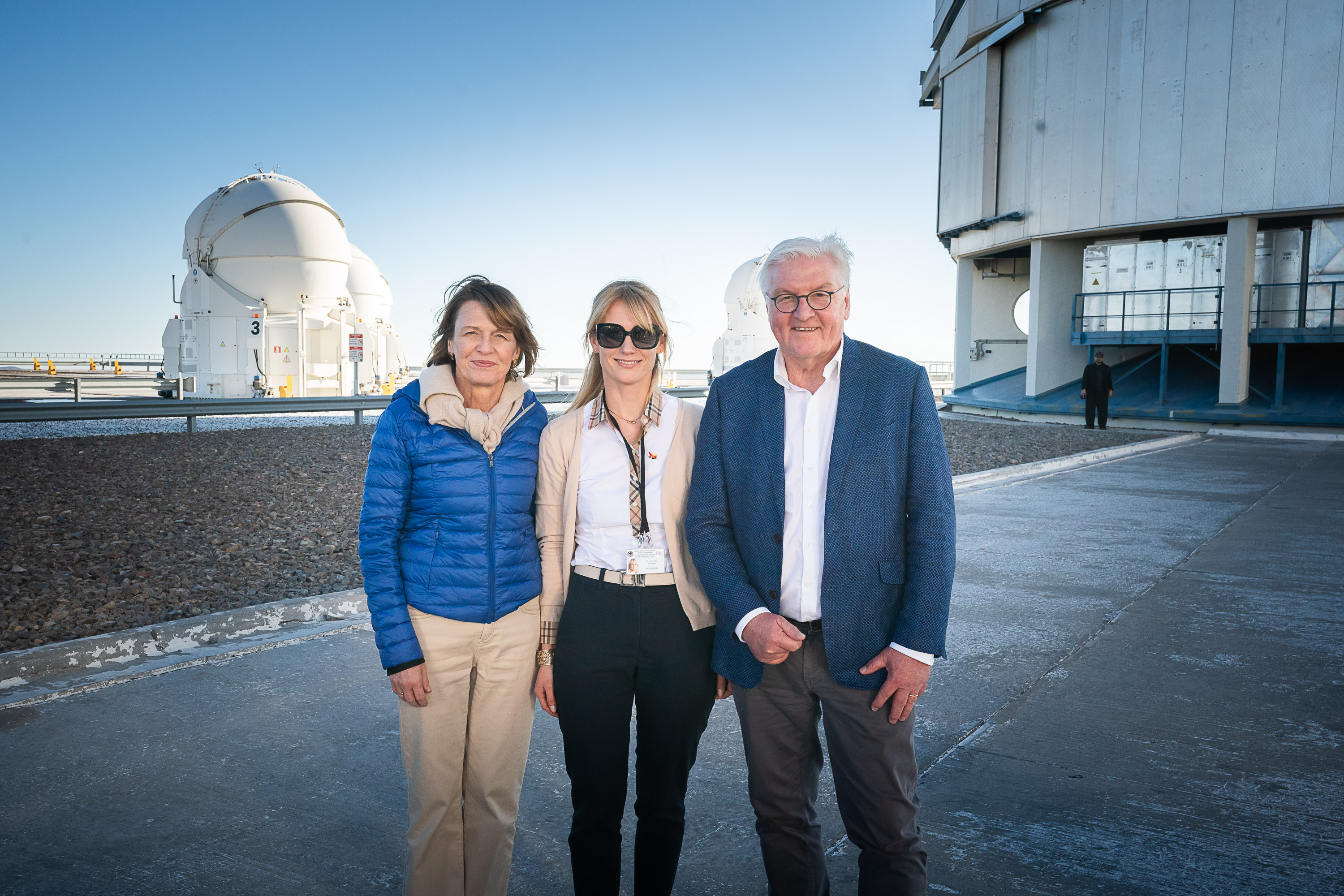
Representing German astrophysics at the VLT and ELT
In March 2025, I accompanied German Federal President Frank-Walter Steinmeier to South America as part of the German delegation representing astrophysics, during an official visit to ESO's Very Large Telescope and the Extremely Large Telescope construction site in Chile, a chance to showcase German contributions to the world's most powerful ground-based observatories.
Research
Current directions
AGN Feedback, Caught in the Act
Quasar feedback is invoked to explain some of the most fundamental relations in galaxy formation, yet catching it in the act and pinning down how accretion energy actually couples to gas on galactic scales has long been one of the field's hardest observational challenges. My group runs multiple JWST programs toward this goal, including the Q3D Early Release Science Program and MILAN together with extensive ground-based follow-up. Rather than single snapshots, we are after the cumulative effect of feedback over a black hole's lifetime, the relic signatures it leaves behind long after the outflow has faded. Of particular interest to our group are red quasars, a population that may be caught in the feedback phase itself.
Q3D ERS website · e.g. Wylezalek+2018, Wylezalek+2017, Wylezalek+2016b, Zakamska+2016
AGN Demographics at Scale
Where JWST gives us a deep, targeted look at individual systems, large spectroscopic and imaging surveys let my group study AGN in bulk. Through programs like the SDSS-IV MaNGA survey, the SDSS-V Black Hole Mapper, and looking ahead to LSST and 4MOST, we mine large statistical samples of AGN and quasar spectra including eROSITA-selected and multi-epoch data to disentangle host-galaxy and nuclear emission and map how AGN properties evolve across cosmic time, turning single-object case studies into population-level demographics.
recent work: 2025–2026 publications
The Build-up of Large-Scale Structure
Galaxy clusters are the most massive gravitationally bound structures in the Universe, assembling from the cosmic web starting around 2 < z < 3. My group has identified ~200 galaxy cluster candidates at z > 1.3, one of the most powerful samples available for studying how galaxies evolve in the densest, most massive environments at high redshift. We continue this work assessing how black hole feedback might have shaped the larger-scale environments around them and vice versa.
e.g. Noirot+2016, Cooke+2016, Cooke+2015, Hatch+2014, Wylezalek+2014, Wylezalek+2013
Curriculum Vitae
Career & recognition
A full version can be obtained upon request.
Professional Experience
Mentor: Nadia Zakamska
Education
Thesis advisors: Carlos De Breuck, Joël Vernet
Host: Daniel Stern
Thesis advisor: Richard McMahon
Thesis advisor: Jochen Heidt
Selected Awards & Media
Publications
Papers & preprints
The complete, up-to-date list is maintained on my NASA ADS private library. My ORCID profile is 0000-0003-2212-6045.
-
SDSS-V Black Hole Mapper: the index diagram as a tool to disentangle the influence of the host galaxy in quasar spectra
-
Optical emission line properties of eROSITA-selected SDSS-V galaxies
-
JWST Q3D Program: Active Galactic Nucleus Photoionization and Shock Ionization in a Red Quasar at z = 0.4
-
Sloan Digital Sky Survey V: Pioneering Panoptic Spectroscopy
Outreach
Book & public engagement

© Daimler und Benz Stiftung / Oestergaard
Talking About the Universe
The dialogue with the public matters a great deal to me. Public funding makes this research possible in the first place, and I see it as part of the job to explain the slow, question-by-question process of figuring things out. Kids in particular ask the best questions, and some of my favourite moments in this job have been standing in front of a room of ten-year-olds who want to know what is really inside a black hole. Giving something back to society, and helping people feel a little more at home in the Universe, is something I try to make time for alongside the research itself.

© Daimler und Benz Stiftung / Oestergaard
Since 2011, I have given invited talks at schools, universities, and public institutions such as the Planetarium Stuttgart, the Zeiss Colloquium, and the Daimler-Benz-Museum, and contributed to public science literacy through media appearances including radio interviews and podcasts. Recurring commitments include Girls’ Day workshops, teacher workshops and talks at the European Researchers’ Night, alongside mentoring a physics students, leading workshops, and taking part in science festivals and institutional open house days.

Alles Zufall im All?
Das geheime Rezept des Universums — Eine Reise von der Entstehung des Weltalls bis zum Menschen
Together with Erik Bertram, and illustrated by Véro Mischitz, I wrote a popular-science book that takes readers from the Big Bang to the emergence of humanity, weaving in the latest JWST discoveries alongside our own research stories along the way and asking how much of it all really came down to chance.
Selected Talks & Public Events
Contact
Get in touch
Astronomisches Rechen-Institut
Zentrum für Astronomie der Universität Heidelberg
Mönchhofstr. 12–14
69120 Heidelberg, Germany
Phone: +49 6221 54 1800
Email: dominika [dot] wylezalek [at] uni [minus] heidelberg.de